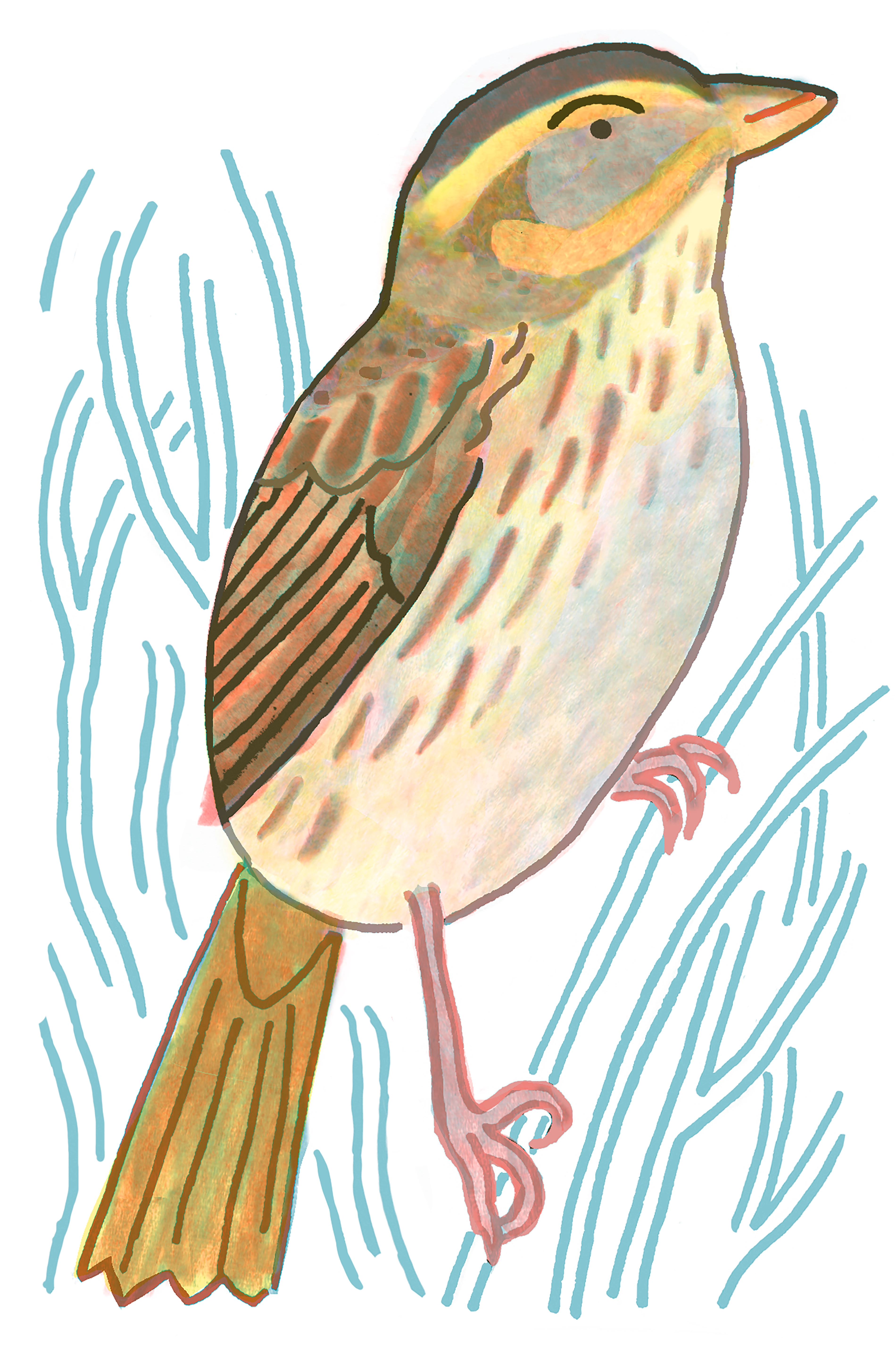
Saltmarsh Sparrow
Ammodramus caudacutus May–Oct
The rarest in this group due to its preference for nesting in salt marshes, this is a monomorphic species, where the female and the male both have identical coloration. The female tends to stay relatively close to the nest, flying away when startled just a short distance until the danger passes. They are the ones who do all the heavy lifting when it comes to raising the chicks, including building the cup-shaped nest, feeding the hatchlings, and removing fecal sacs to keep the nest clean and free of odors that attract predators. The nest is constructed just a few inches above the ground using available marsh grass and reeds, with the plant stems providing additional support along the sides.
The Saltmarsh Sparrow Research Initiative has been monitoring the species actively since 2016, using Jacob's Point as their primary location for field research. These birds construct nests that are invisible to the untrained eye since they are snugly built into the sea of marsh grasses. Laying between three to five pale-colored eggs patterned with a fine mist of brown dots, the female incubates them for 12 days and feeds the hatchlings for 10 days before they are ready to fledge and leave the nest.
These birds are in serious danger of extinction within the coming decades. They are extremely vulnerable due to their nesting behavior and breeding solely in salt marshes found along the northeast coast of the US. Due to climate change and rising water levels, salt marshes have been flooding with greater frequency, which results in eggs floating away and the drowning of hatchlings. According to the US Fish & Wildlife service, an estimated 87% of the population has disappeared since 1998.